Question No
|
Question
|
Correct Ans
|
101
|
DIRECTION (Qs. 101 to 110): Read the following passages carefully and answer the questions given below it. Certain words/phrases have been printed in bold to help you locate them while answering some of the questions.
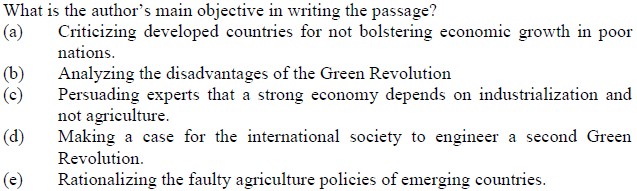
Governments have traditionally equated economic progress with steel mills and cement factories. While urban centers thrive and city dwellers get rich, hundreds of millions of farmers remain mired in poverty. However, fears of food shortages, a rethinking of antipoverty priorities and the crushing recession in 2008 are causing a dramatic shift inworld economic policy in favors of greater support for agriculture.
The last time when the world’s farmers felt such love was in the 1970s. At that time, as food prices spiked, there was real concern that the world was facing a crisis in which the planet was simply unable to produce enough grain and meat for an expanding population.
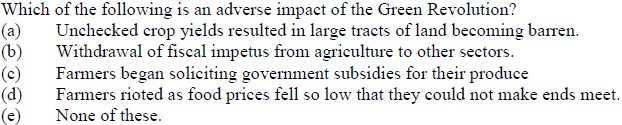
Governments across the developing world and international aid organizations plowed investment into agriculture in the early 1970s, while technological breakthroughs, like high yield strains of important food crops, boosted production. The result was the Green Revolution and food production exploded.
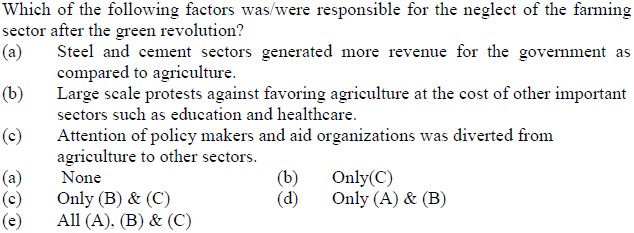
But the Green Revolution became a victim of its own success. Food prices plunged by some 60% by the late 1980s from their peak in the mid – 1970s. Policymakers and aid workers turned their attention to the poor’s other pressing seeds, such as health care and education. Farming got starved of resources and investment. By 2004, aid directed at agriculture sank
to 3.5% and “Agriculture lost its glitter.” Also, as consumers in high- growth giants such as China and India became wealthier, they began eating more meat, so grain once used for human consumption got diverted too beef up livestock.
By early 2008, panicked buying by importing countries and restrictions slapped on grain exports by some big producers helped drive prices up too heights not seen for three decades. Making matters worse, land and resources got reallocated to produce cash crops such as biofuels and the result was that voluminous reserves of grain evaporated. Protests broke out across the emerging world and fierce food riots toppled governments.
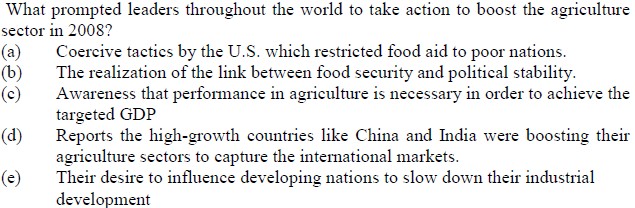
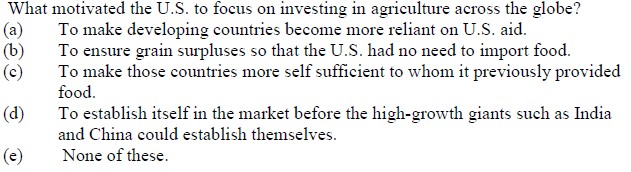
This spurred global leaders into action. This made them aware that food security is one of the fundamental issues in the world that has to be dealt with in order to maintain administrative and political stability. This also spurred the U.S. which traditionally provisioned food aid from American grain surpluses to help needy nations, to move towards investing in farm sectors around the globe to boost productivity. This move helped countries become more productive for themselves and be in a better position to feed their own people.
Africa, which missed out on the first Green Revolution due to Poor policy and
limited resources, also witnessed a ‘Change’ swayed by the success of East Asia, the primary poverty-fighting method favored by many policymakers in Africa was to get farmers off their farms and into modern jobs in factories and urban centers. But that strategy proved to be highly insufficient. Income levels in the countryside badly trailed those in cities while the FAO estimated that the number of poor going hungry in 2009 reached an all time high at more than one billion.
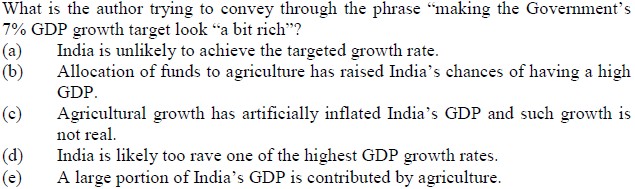
In India on the other hand, with only 40% of its farmland irrigated, entire economic boom currently underway is held hostage by the unpredictable monsoon. With much of India’s farming areas suffering from drought this year, the government will have a tough time meeting its economic growth targets. In a report, Goldman Sachs predicted that if this year too receives weak rains, it could cause agriculture to contract by 2% this fiscal year, making the government’s 7% GDP – growth target look “a bit rich”. Another green
revolution is the need of the hour and to make it a reality, the global community still has much backbreaking farm work to do.
 |
Correct Ans: D
|
102
|
 |
Correct Ans: B
|
103
|
 |
Correct Ans: C
|
104
|
 |
Correct Ans: B
|
105
|
 |
Correct Ans: B
|
106
|
 |
Correct Ans: C
|
107
|
What impact did the economic recession of 2008 have on agriculture?
(a) Governments equated economic stability with industrial development and
shifted away from agriculture.
(b) Lack of implementation of several innovative agriculture programs owing to
shortage of funds.
(c) It prompted increased investment and interest in agriculture.
(d) The GDP as targeted by India was never achieved because of losses in
agriculture.
(e) None of these.
|
Correct Ans: C
|
108
|
What encouraged African policymakers to focus on urban jobs?
(a) Misapprehension that it would alleviate poverty as it did in other countries.
(b) Rural development outstripped urban development in many parts of Africa.
(c) Breaking out of protests in the country and the fear that the government would topple.
(d) Blind imitation of western models of development
(e) None of these.
|
Correct Ans: A
|
109
|
Which of the following had contributed to exorbitant food prices in 2008?
(A) Hoarding of food stocks by local wholesalers which inadvertently created a food shortage.
(B) Export of food grains was reduced by large producers.
(C) Diverting resources from cultivation of food grains to that of more profitable crops.
(a) None (b) Only (C)
(c) Only (B)
(d) All (A), (B) & (C)
(e) Only (B) & (C)
|
Correct Ans: E
|
110
|
Which of the following is true about the state of agriculture in India at present?
(A) Of all the sectors, agriculture needs the highest allocation of funds.
(B) Contribution of agriculture to India’s GDP this year would depend greatly upon the
monsoon rains.
(C) As India is one of the high-growth countries, it has surplus food reserves to export to
other nations.
(a) Only (A) & (C)
(b) Only (C)
(c) Only (B)
(d) Only (B) and (C)
(e) None of these
|
Correct Ans: C
|